Charting Data Packet Prioritization Protocols to Minimize Desync Issues During Cooperative Raids in Persistent Online Worlds
Written by Kai Koch · Jun 24, 2026
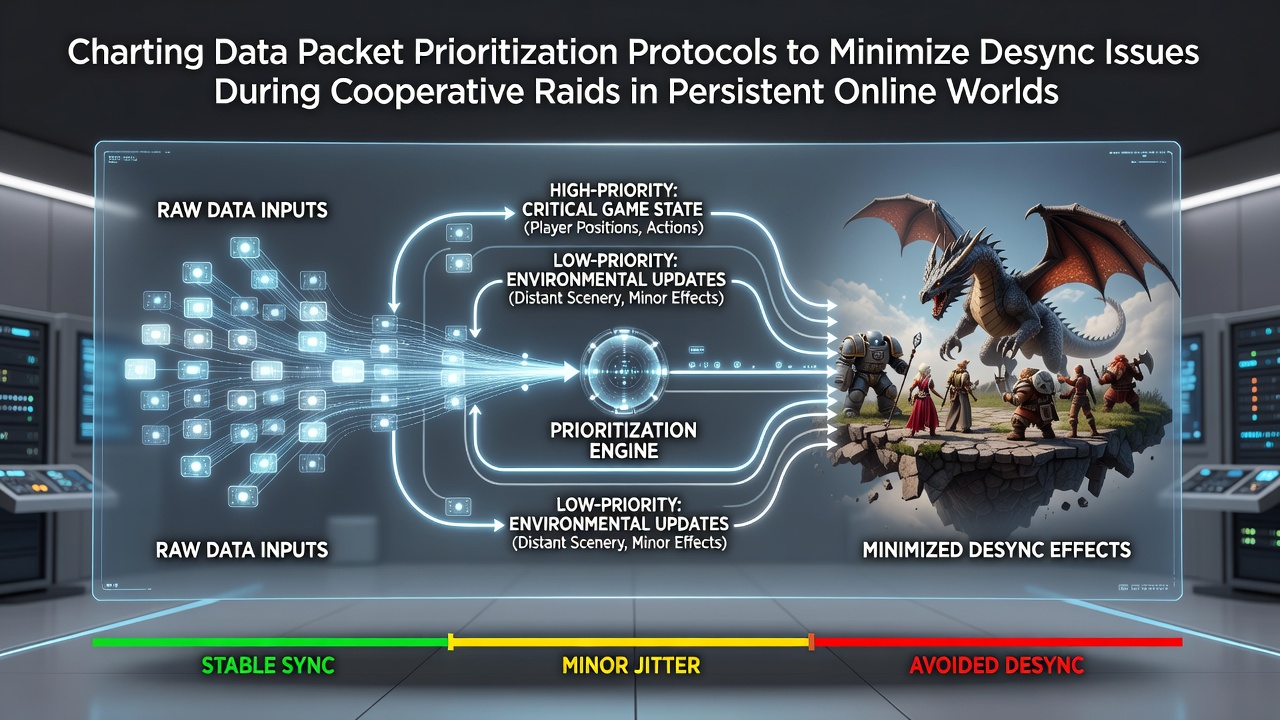
Charting Data Packet Prioritization Protocols to Minimize Desync Issues During Cooperative Raids in Persistent Online Worlds
Persistent online worlds rely on continuous exchanges of data packets that carry player positions, actions, and environmental states, yet desynchronization emerges when these packets arrive out of sequence or face delays during intense cooperative raids. Researchers have mapped packet prioritization protocols that assign higher transmission precedence to critical raid elements such as movement vectors and ability activations while relegating secondary data like cosmetic updates to lower queues. This approach stems from foundational networking principles where latency spikes in shared instances can cause players to witness mismatched events, including attacks landing without visual confirmation or group members appearing in incorrect locations. Studies from institutions across North America and Europe indicate that desync rates drop measurably when protocols implement dynamic weighting based on raid phase intensity. In June 2026, industry gatherings highlighted refinements to these systems as developers integrated machine learning classifiers to predict packet urgency from historical raid telemetry. Observers note that such classifications allow servers to allocate bandwidth more effectively during synchronized boss mechanics where timing windows span fractions of a second.Core Mechanisms Behind Packet Prioritization
Data packet prioritization operates through layered queues that evaluate payload importance using metrics like temporal relevance and dependency chains, which means an incoming heal request packet receives expedited routing over a loot distribution update. Engineers at various game studios apply variants of weighted fair queuing adapted from telecommunications standards, ensuring that cooperative raid groups maintain consistent world states even under packet loss conditions exceeding five percent. Those who've analyzed server logs from large-scale persistent titles report that unprioritized streams often produce position drift exceeding two meters within ten seconds of sustained activity.
Transmission protocols further incorporate forward error correction tailored to high-priority packets, allowing reconstruction of lost raid coordination data without full retransmission requests that compound latency. Academic examinations conducted at universities in Australia and Japan reveal correlations between these corrections and reduced instance reset frequencies in persistent environments.
Application in Cooperative Raid Scenarios
During multi-phase encounters that involve dozens of participants, prioritization frameworks sequence action confirmations ahead of environmental effect broadcasts because desynced ability resolutions can cascade into group wipes. Teams coordinating across regions benefit when servers tag inter-player collision data with elevated flags, which prevents scenarios where one client registers a successful dodge while another processes an overlapping hit registration. Evidence from telemetry aggregates shows that such tagging aligns client predictions more closely with authoritative server ticks.
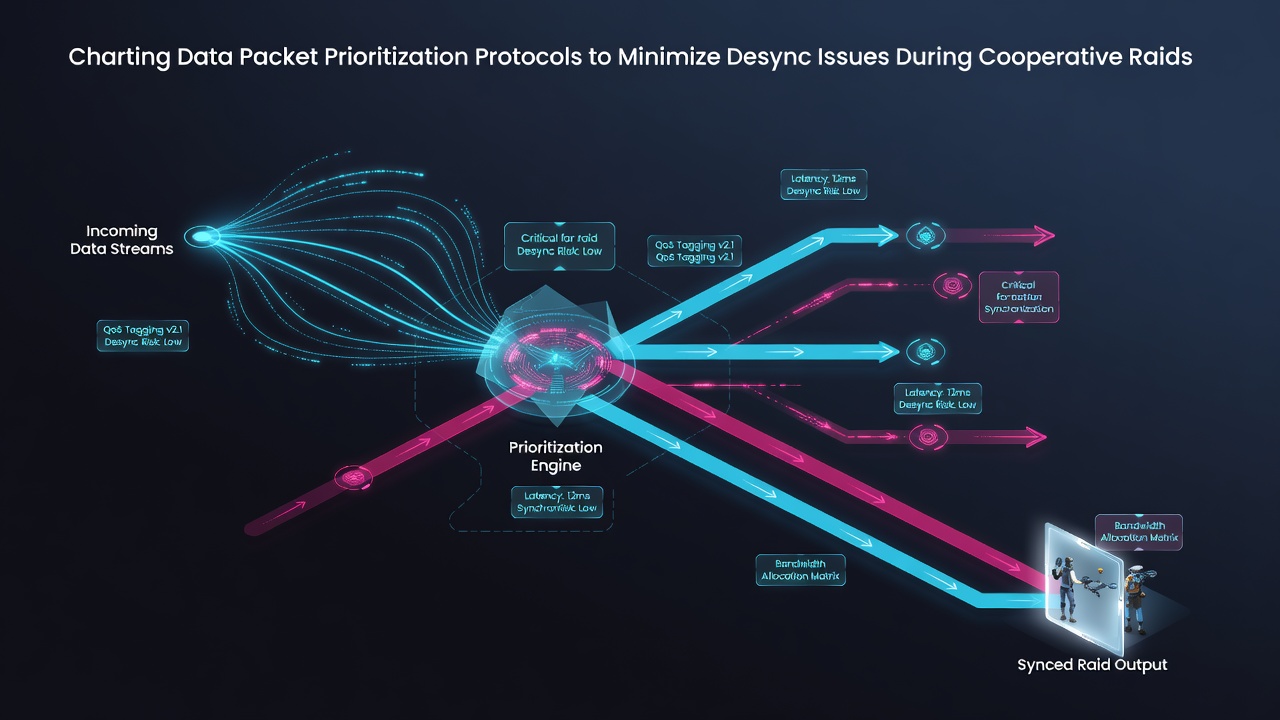
Additional layers involve adaptive throttling that monitors aggregate raid traffic and reallocates resources when congestion thresholds activate, which maintains fluidity across heterogeneous network conditions. Data from regional infrastructure reports compiled by Canadian research bodies demonstrates consistent improvements in synchronization metrics after these throttles were deployed in production environments.
Integration Challenges and Observed Outcomes
Implementing these protocols requires careful calibration to avoid starving lower-priority channels that still contribute to immersion, such as voice-over triggers or ambient effect synchronization. Developers address this through hybrid models that blend strict priority with reserved minimum bandwidth allocations for non-critical streams. Figures released by the Entertainment Software Association indicate that titles adopting refined prioritization experienced measurable declines in player-reported desync complaints during peak raid hours.
Further refinements draw from cross-industry collaborations where gaming networks borrow congestion control algorithms tested in European smart grid communications. These borrowings allow persistent worlds to handle sudden spikes in participant density without proportional increases in state divergence.
Conclusion
Packet prioritization protocols continue to evolve as persistent online worlds scale in complexity, with ongoing work focusing on predictive models that anticipate raid event sequences. Researchers across multiple continents document steady gains in synchronization fidelity through iterative protocol adjustments, supporting smoother cooperative experiences even as participant numbers and mechanical intricacy grow. Continued examination of these systems promises additional refinements that align data delivery more precisely with the demands of shared virtual spaces.