Integrating Player Movement Data with Environmental Sound Maps for Stealth Navigation in Tactical Espionage Simulations
Written by Kai Koch · Aug 17, 2026
Integrating Player Movement Data with Environmental Sound Maps for Stealth Navigation in Tactical Espionage Simulations
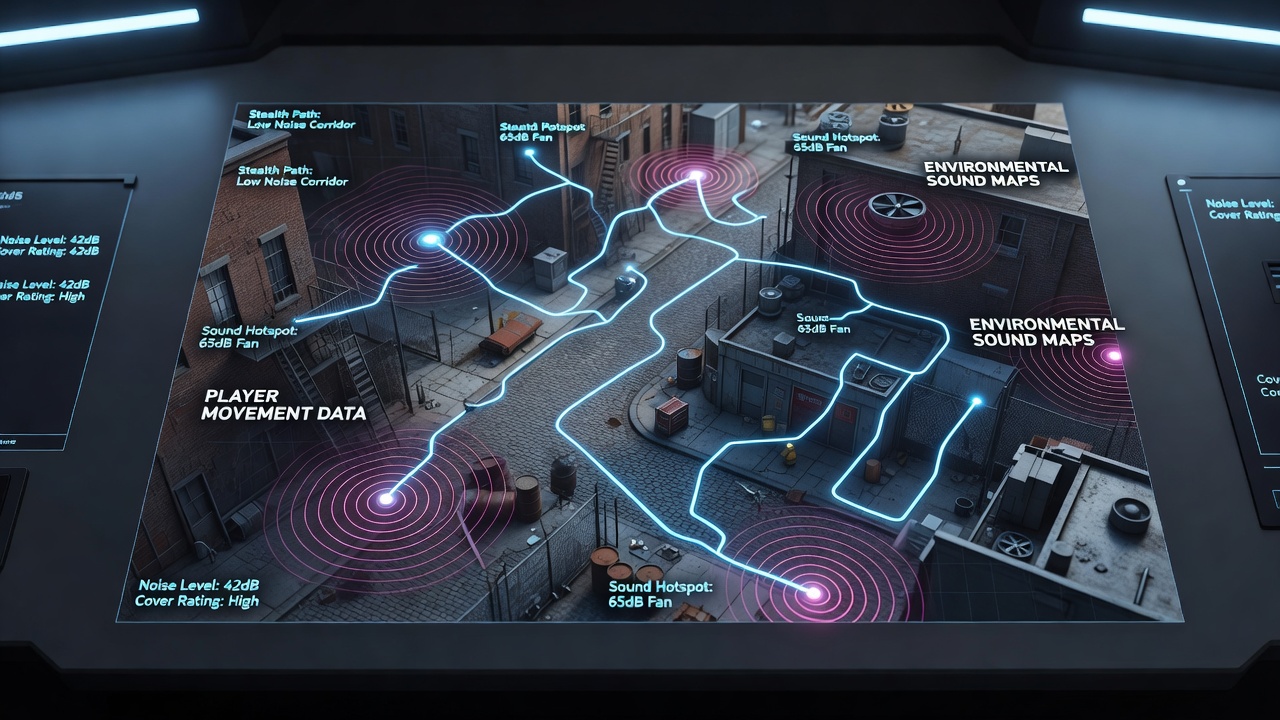
Player movement data combines velocity vectors, footstep timing, and posture states with environmental sound maps that model occlusion, reverberation, and attenuation across virtual spaces, and this integration supports precise stealth navigation in tactical espionage simulations where detection thresholds depend on audio signatures reaching non-player characters.
Studies from game audio research groups indicate that real-time calculation of sound pressure levels at enemy positions relies on layered grid systems, while movement inputs feed directly into those calculations to adjust volume and timing on the fly.
Capturing and Processing Movement Inputs
Simulations track character locomotion through continuous sampling of analog inputs and animation states, and developers convert these streams into acoustic event markers that include speed multipliers and surface interaction coefficients. Data from motion capture sessions shows how crouch speeds reduce generated noise by measurable decibel ranges compared with sprint cycles, and engines apply these values to dynamic audio emitters attached to the player model.
Engineers at several studios have documented that integrating inertial measurement data from controller hardware further refines predictions of landing impact sounds during vault or drop maneuvers, and this approach allows systems to anticipate sound events before they occur in the simulation timeline.
Constructing Environmental Sound Maps
Sound maps divide level geometry into voxel or navmesh subdivisions that store material absorption values, room volumes, and line-of-sight occlusion flags, and these structures update when doors open or objects move. Research papers from European digital media labs describe how ray-tracing or wave-based propagation methods populate each cell with frequency-dependent decay rates, while precomputed reverb zones handle late reflections separately from direct path calculations.
August 2026 updates to major middleware packages introduced faster GPU-accelerated baking for these maps, enabling larger open levels without sacrificing accuracy during runtime queries.
Combining Data Streams for Detection Logic
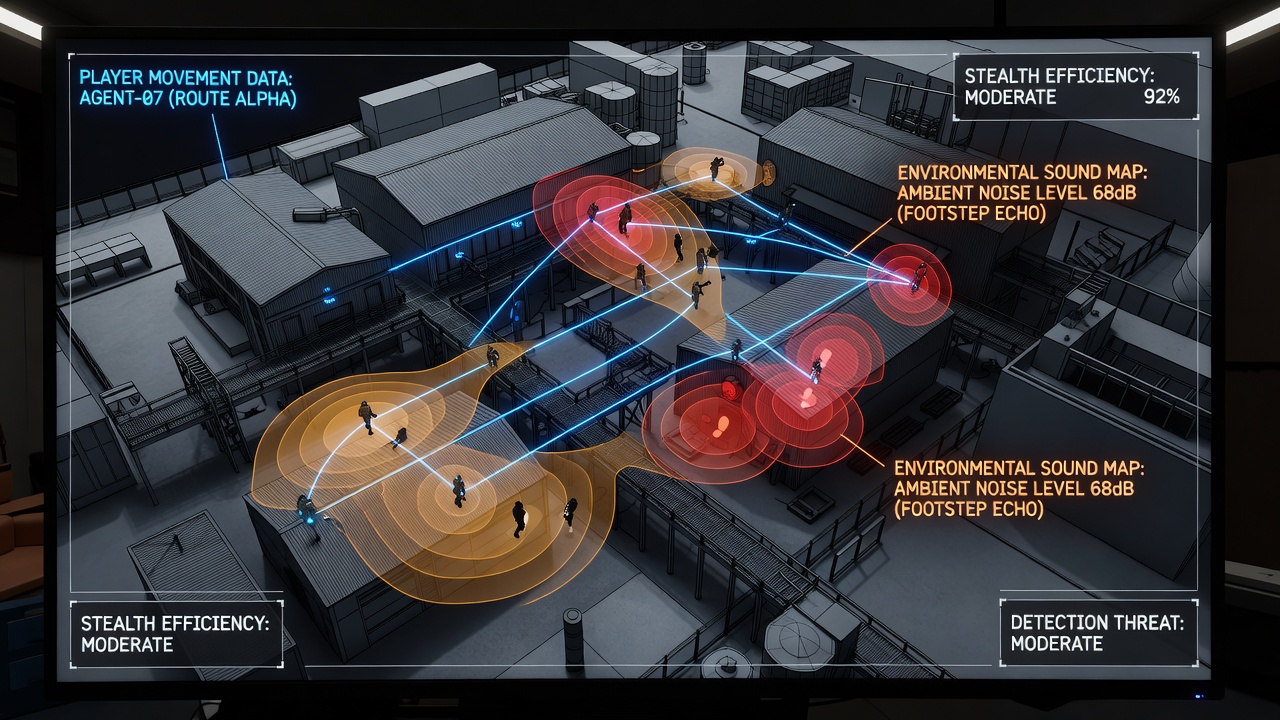
Once movement events generate candidate sound sources, the simulation queries nearby map cells to determine final intensity at each listener position, and this process accounts for player stance, carried equipment weight, and surface type in a single pass. Observers note that AI agents then compare received values against per-character hearing thresholds that vary with alertness states and distance falloff curves.
Case examples from published post-mortems reveal that chaining multiple short movement segments rather than long runs keeps cumulative sound energy below detection lines, and systems often expose these thresholds through visual debug overlays during development.
Implementation Patterns Across Current Titles
Tactical espionage titles released in recent years use modular audio graphs that accept movement telemetry as input parameters, and this design lets designers tweak individual variables without rebuilding entire propagation systems. Industry reports from the Interactive Games and Entertainment Association in Australia highlight adoption rates of hybrid CPU-GPU pipelines that handle both real-time path tracing for nearby sources and pre-baked attenuation for distant zones.
Developers link these pipelines to animation notifies so that footstep events trigger only when weight transfer completes, which prevents false positives during idle shifts or slow turns.
Performance Considerations and Optimization
Integrating dense movement data with high-resolution sound maps increases CPU load during crowded scenes, yet profiling data from console and PC builds shows that spatial partitioning and event culling keep frame times stable. Techniques such as distance-based LOD for sound sources and asynchronous map updates reduce contention, while memory budgets allocate separate buffers for movement history queues that feed predictive sound modeling.
Academic work from Canadian institutions on real-time audio middleware confirms that these optimizations maintain sub-millisecond query times even when hundreds of dynamic emitters coexist with static geometry.
Conclusion
Integration of player movement telemetry with environmental sound maps produces detection systems that respond consistently to locomotion choices, and ongoing middleware improvements continue to expand the scale and fidelity of these simulations. Data from multiple sources demonstrates measurable gains in navigation precision when teams align animation timing, surface properties, and propagation models within unified pipelines.