Interpreting Network Latency Patterns to Time Ultimate Abilities in Multiplayer Arena Battles
Written by Quinn Beck · Jun 22, 2026

Interpreting Network Latency Patterns to Time Ultimate Abilities in Multiplayer Arena Battles
Network latency affects how players synchronize actions in real-time multiplayer arena battles, where timing ultimate abilities often determines match outcomes. Data from competitive gaming environments indicates that latency values typically range between 20 and 100 milliseconds in stable connections, while spikes above 150 milliseconds introduce noticeable delays in ability activation feedback. Researchers at institutions like the University of California have documented patterns where consistent jitter intervals allow experienced participants to predict server reconciliation points and align ultimate casts accordingly.Core Components of Latency Analysis
Latency consists of several measurable elements including round-trip time, packet loss rates, and jitter variance, each of which influences the window available for executing high-impact abilities. Studies from the IEEE Computer Society reveal that packet loss exceeding 1 percent frequently disrupts the client-server state synchronization required for ultimate ability resolution, forcing players to adjust their timing strategies based on observed delay sequences. Those monitoring these metrics often track baseline ping during lobby phases before matches begin, establishing reference points that highlight deviations during active gameplay.
Multiplayer arena titles rely on authoritative server models that reconcile player inputs at fixed tick rates, commonly 60 or 120 ticks per second. When latency patterns show periodic 50-millisecond oscillations, observers note that these cycles align with ability wind-up animations in many titles, enabling preemptive input buffering to compensate for transmission delays. Data collected during major esports events in June 2026 demonstrated that teams utilizing real-time latency overlays achieved higher ultimate hit rates in coordinated engagements compared to those relying solely on in-game indicators.
Pattern Recognition in Live Matches
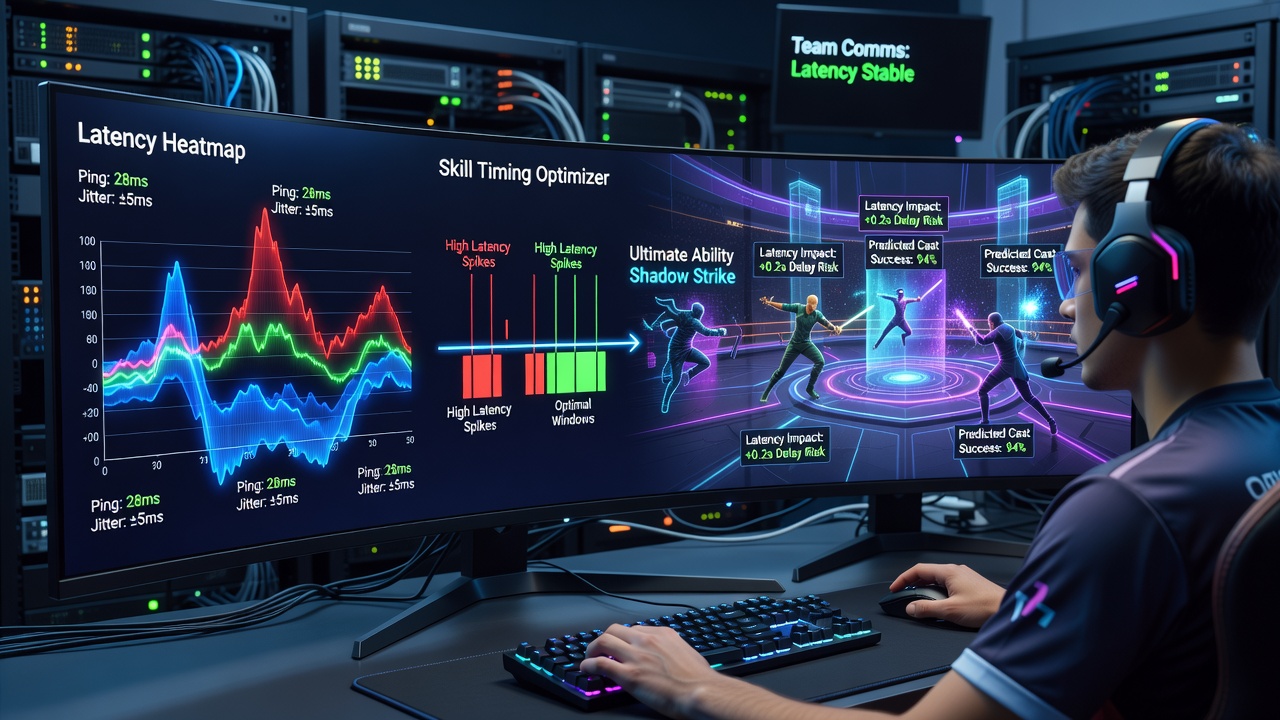
Players interpret latency graphs by identifying recurring spike clusters that correlate with server load increases during large-scale team fights. Research published through the Association for Computing Machinery highlights how jitter patterns above 30 milliseconds create uncertainty windows that extend beyond standard ability cast times, prompting adjustments such as early activation or delayed follow-ups. In practice, participants examine rolling averages over 10-second intervals to distinguish transient noise from structural network issues that affect ultimate timing reliability.
Geographic server routing contributes additional variables, as routes through transatlantic or transpacific nodes introduce baseline offsets that skilled players factor into their decision trees. Reports from the Australian Interactive Games Association indicate that regional qualifiers in 2026 tournaments frequently featured latency differentials of 40 to 80 milliseconds between player groups, requiring adaptive timing models rather than fixed offsets. Those analyzing these differences often cross-reference packet capture logs with replay data to validate correlations between observed delays and successful ultimate executions.
Practical Application Techniques
Software tools integrated into client overlays display latency heatmaps that update at sub-second intervals, allowing participants to anticipate periods of elevated delay before committing ultimate resources. According to findings from the European Network and Information Security Agency gaming network studies, teams that incorporated predictive algorithms reduced mistimed abilities by measurable margins across sampled matches. The process involves logging historical latency distributions for specific match types and applying statistical thresholds to flag high-risk activation moments.
Input buffering mechanics in arena battle engines provide a secondary layer of compensation, where players queue commands during detected low-latency windows to ensure execution aligns with server ticks. Evidence from university-led simulations shows that combining latency pattern recognition with buffer window calibration produces more consistent ultimate outcomes than either method alone. Observers have recorded instances where players adjusted their cast timing by 80 to 120 milliseconds based on preceding jitter trends, maintaining effectiveness despite fluctuating connection quality.
Limitations and Data Considerations
Network conditions remain subject to external factors such as ISP routing changes and regional congestion events that can invalidate previously established patterns mid-match. Figures released by the Canadian Centre for Cyber Security in collaborative esports research note that sudden route flaps occasionally produce latency shifts exceeding 200 milliseconds, rendering prior timing models ineffective until new baselines form. Participants therefore maintain multiple contingency strategies rather than relying on single-pattern interpretations.
Hardware differences between client machines also influence how latency manifests in ability feedback loops, with variations in rendering pipelines and input polling rates adding secondary delays. Academic analyses from institutions across Asia-Pacific regions emphasize that standardized testing protocols help isolate network effects from hardware contributions during competitive play.
Conclusion
Interpreting network latency patterns provides a measurable framework for optimizing ultimate ability timing in multiplayer arena battles through systematic observation of delay metrics and their correlations with game state updates. Continued data collection from organized events supports refinement of these approaches across evolving network infrastructures.